DGrid2026-08-27 09:21:33DGrid launches validator nodes to extend PoQ into an economically weighted AI verification networkDGrid said it launched validator nodes on Aug. 25, 2026, framing the move as an upgrade to how trust is established in AI infrastructure rather than a routine product addition. The company’s system centers on PoQ, short for Proof of Quality, a verification mechanism it says is used to audit the quality of model services across its network. With validator nodes now live, that process is no longer described only at the protocol level. It is carried out continuously by network participants and linked to staking through operating weight. According to DGrid’s description, validator nodes send randomized blind-test requests to LLM providers, simulate production-like usage instead of relying on fixed benchmarks, score outputs across quality, latency, stability and format compliance, and then write the results on-chain. The stated goal is to detect cases in which a provider’s real service diverges from what it claims to offer, including model substitution, degraded service tiers or opaque routing. DGrid also ties the system to $DGAI staking. Users can delegate tokens to validator nodes, and stake affects each node’s operating weight inside the network. DGrid’s staking page shows that 48 hours after validator nodes went live, total staked volume had exceeded 26M $DGAI, with nearly 10,000 users participating. The broader architecture described by DGrid includes an AI Gateway, a Model Marketplace, PoQ-based verification, validator-node execution and staking-based economic security.970
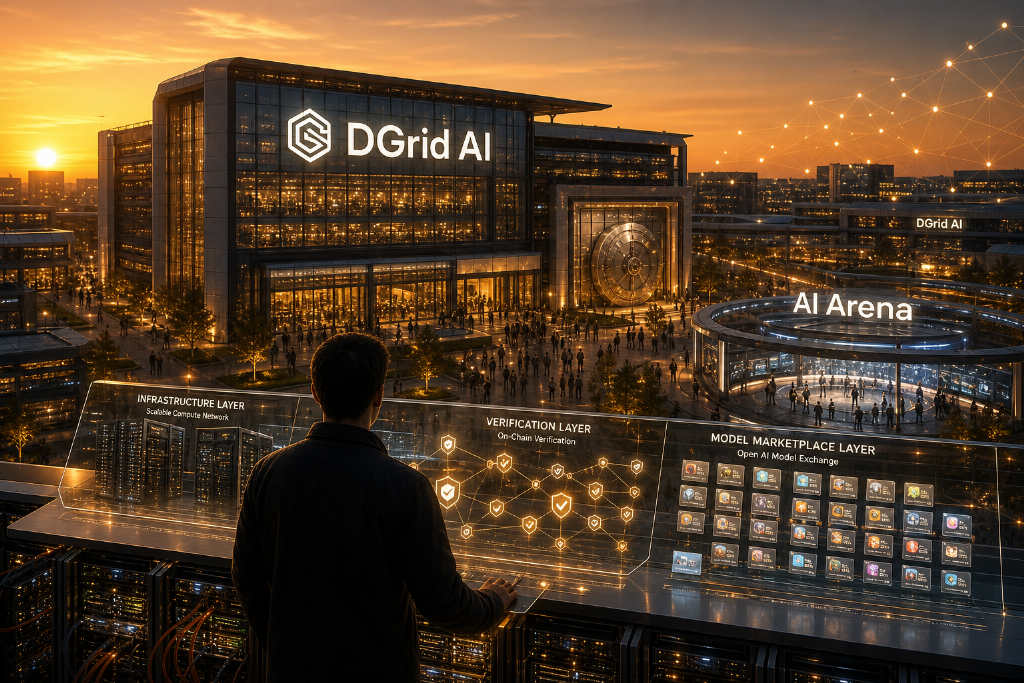
DGrid AI2026-08-19 07:48:56DGrid AI pitches on-chain verification and open markets as a new stack for AI infrastructureDGrid AI is positioning itself as a decentralized AI infrastructure protocol built around three pieces: a unified access layer for model calls, an on-chain quality verification system called Proof of Quality, and an open marketplace for model providers. In the report cited by Foresight, the project argues that today’s centralized AI platforms still leave developers and enterprises exposed to three structural problems: opaque service quality, vendor lock-in, and closed value distribution. The article says DGrid has already served more than 15,000 paying users as of the first half of 2026 and generated $23 million in verification revenue, while its AI Arena has drawn more than 500,000 users to take part in model evaluation. With the release of the $DGAI token model and an upcoming token generation event, DGrid is presented as moving from an AI service product toward a decentralized infrastructure protocol. The piece also details DGrid’s broader product lineup, including AI Gateway for developers, Model Marketplace for suppliers, AI Arena for preference and evaluation data, and DClaw for agent deployment and on-chain identity. It describes $DGAI as a coordination token for staking, payments, incentives, and governance, while framing the next test for the project around whether existing revenue and user activity can translate into sustained decentralized network usage.2580
DGrid2026-07-23 09:51:43DGrid launches Model Marketplace to monetize idle GPUs, cheap power and niche AI modelsDGrid has rolled out its Model Marketplace with a pitch aimed at both sides of the AI stack: owners of underused GPU capacity, teams with excess internal compute, and developers with vertical fine-tuned models that struggle to find buyers. The platform’s idea is to put those fragmented resources into one open market where providers can list models directly, set their own prices, and receive on-chain settlement when calls are made. The company draws a line between its approach and the broker-style model common among many AI aggregation platforms. In DGrid’s description, those platforms often operate as black boxes, controlling supply access, pricing and distribution terms without exposing much of that information to users. DGrid says its marketplace is meant to work as open infrastructure instead, broadening who can participate on the supply side. The launch also leans heavily on PoQ, or Proof of Quality, a mechanism DGrid says is designed to verify providers rather than inspect each user request. The company says it uses its own benchmark datasets for independent random spot checks, then records results on-chain without touching user request data. According to the article, DGrid currently aggregates more than 200 models including Claude, GPT, Gemini, MiniMax and GLM, has over 15,000 paying users, and generated more than $23 million in revenue in the first half of 2026 after raising a $5 million seed round.1580
DGrid2026-07-17 10:43:34DGrid says Genesis revenue topped $23 million in H1 as decentralized AI moves into paid usageDGrid said its Genesis membership program generated more than $23 million in the first half of 2026, with over 15,000 paying members, offering one of the clearest revenue figures so far for a decentralized AI product built around direct user payments rather than token narrative alone. The company positions itself not as a simple compute marketplace, but as a verifiable AI service network connecting developers, enterprise users and crypto-native users. The report says members pay $1,580 a year and receive $300 in monthly model credits, an exclusive NFT, one-click deployment through DClaw, and DGAI token mining rewards. DGrid also highlighted a broader product lineup that includes AI Gateway, AI Arena, DClaw, Model Marketplace and the Dori recommendation agent. AI Arena alone has attracted more than 300,000 participants, according to the article. At the core of the project is Proof of Quality, or PoQ, a mechanism designed to verify whether model providers actually deliver the AI services they claim to offer. DGrid has also integrated with BNB Chain through Agent Registry and x402 payment capabilities, giving AI agents on-chain identity and pay-per-request settlement. The article frames these pieces as part of a larger attempt to turn decentralized AI from a technical idea into a service network with transparent calling, verification, billing and settlement.820